
If a hosting provider advertises a 10 Gbps server, does your own traffic move at 10 gigabits per second? Usually not. The figure normally describes the shared network backbone, while your server has its own, often lower, per-server bandwidth.
What Does “10 Gbps” Mean on a Dedicated Server?
When a provider advertises a 10 Gbps plan, it typically means the server connects to a 10 Gbps network backbone, the shared infrastructure that links a data center’s servers to the internet [1]. It does not mean your server gets a personal 10-gigabit connection.
On our 10 Gbps plans, each server has 1 Gbps of unmetered bandwidth and connects through that 10 Gbps backbone.
Gbps (gigabits per second) and GBps (gigabytes per second) are not the same. A gigabyte is 8 gigabits, so a 10 Gbps link tops out around 1.25 gigabytes per second, not 10. Network speeds are usually quoted in bits per second [2].
Network Backbone vs. Per-Server Bandwidth
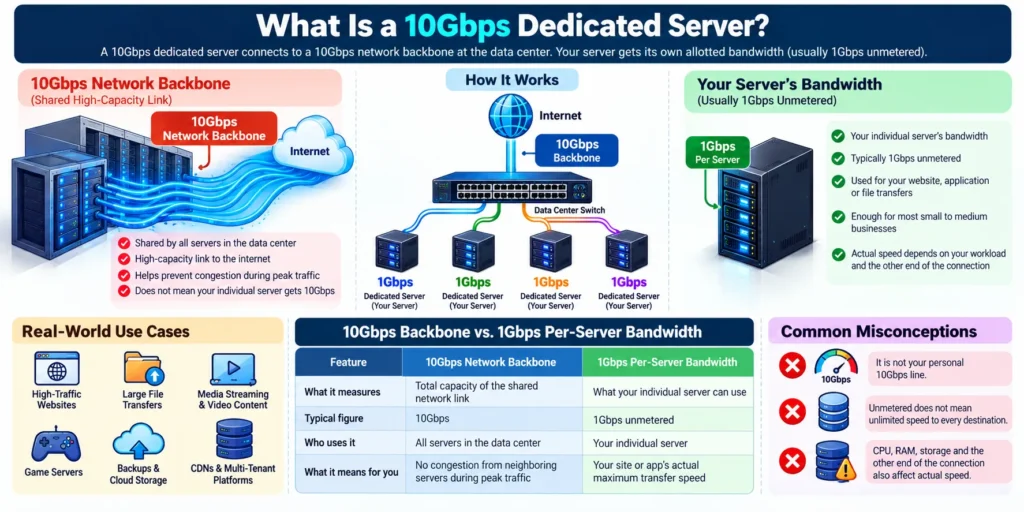
The network backbone is the shared, high-capacity link between a data center’s servers and the wider internet. Per-server bandwidth is the transfer rate allotted to your own server [3]. It decides how fast your site, app or file transfers can go, and it is usually far lower than the backbone figure.
A 10 Gbps backbone gives the shared link room for a lot of combined traffic, which lowers the chance of congestion. It cannot rule it out if many servers peak at once, and it does not let any single server push 10 Gbps.
| Factor | Network backbone | Per-server bandwidth |
|---|---|---|
| What it measures | Total capacity of the shared network link | What your own server can use |
| On our plans | 10 Gbps | 1 Gbps unmetered |
| What it means for you | Lower chance of congestion during traffic spikes | Your server’s maximum transfer speed |
How a 10 Gbps Backbone Is Built
A 10 Gbps backbone is not one wire to every server. Servers connect into switches, which connect upward through higher-capacity uplinks toward the internet. The ratio between a switch’s downlink and uplink capacity is called oversubscription. A well-designed network keeps that ratio low enough that normal traffic rarely bottlenecks, even though no single uplink could carry every server at full speed at once [4].
Do You Need a 10 Gbps Backbone Dedicated Server?
Most small and medium sites never come close to saturating 1 Gbps, so backbone speed is rarely the deciding factor for them. The bigger question is whether a dedicated server, rather than shared hosting or a VPS, is the right tier at all. For a small business site or a dev/staging environment, a VPS or a smaller plan is usually enough. See RDP vs VPS if you are still deciding.
A 10 Gbps backbone plan is worth it when:
- You share infrastructure with many high-traffic tenants and see congestion at peak hours.
- You run bandwidth-heavy workloads such as large file distribution, a media-heavy store or a growing game server.
- You want headroom so traffic spikes are not throttled by a congested shared link, even if your daily use is modest.
Real-World Bandwidth Needs: Backups and CDNs
A large nightly backup is limited by the slower end of the connection, so a congested link or a slow destination can bottleneck it even on a server advertised as “10 Gbps”.
CDNs and multi-tenant VPS platforms are the clearest case where backbone capacity matters directly, since many tenants share one physical uplink.
Our 10 Gbps plans pair 1 Gbps of unmetered bandwidth per server with a 10 Gbps network backbone, on Intel Xeon E-2136 hardware with Windows Server and a dedicated IPv4 address. Current specs and prices are listed on the plans page.
Billing Models: Unmetered, Metered and 95th Percentile
Unmetered plans, like our 10 Gbps tier, cap your transfer rate but do not charge extra for data moved. Metered plans charge by the gigabyte or terabyte transferred. Many larger providers use 95th-percentile billing, which discards the top 5% of usage spikes and bills on what is left.
Common Mistakes When Evaluating “10 Gbps” Hosting Claims
- Assuming the advertised 10 Gbps is your server’s own bandwidth. Always check the per-server figure on the plan page.
- Comparing one provider’s backbone number with another provider’s per-server number. That is not a like-for-like comparison.
- Ignoring other bottlenecks. Disk I/O, RAM and CPU can limit performance as much as network speed.
- Assuming more bandwidth means better DDoS protection. It does not. Volumetric attacks need dedicated mitigation [5].
How to Verify Your Server’s Throughput
The only way to know your per-server bandwidth is to measure it. iperf3, an open-source tool, measures sustained throughput between your server and a second endpoint, which shows whether an advertised figure holds up under a real transfer rather than a short burst [6].
Conclusion
Before you compare plans or providers, look for the per-server bandwidth figure. For most workloads, enough unmetered bandwidth and the right CPU, RAM and storage matter more than the backbone number. Ready to buy? Read Buy RDP Online: Plans, Prices and What to Check.
Frequently Asked Questions
What’s the difference between port speed and bandwidth?
Port or backbone speed is the capacity of the network link. Bandwidth is the part allotted to your server. A 10 Gbps backbone with 1 Gbps per server is a common setup, not a contradiction.
Is 10 Gbps overkill for a small website?
Usually yes. A small site rarely uses even 1 Gbps. It matters for large file distribution, media-heavy stores or unpredictable traffic spikes.
How can I check my server’s real speed?
Run iperf3 between your server and a second endpoint and look at the sustained throughput.
When do you need 10 Gbps hosting?
When you run bandwidth-heavy workloads such as large file distribution, a media-heavy store or a busy game server, or when you share infrastructure with high-traffic tenants and see congestion at peak hours. Most small and medium sites never come close to saturating 1 Gbps.
2 thoughts on “What Is a 10Gbps Dedicated Server? Backbone vs Bandwidth”
Comments are closed.