

Its value is email IP standing, server isolation and control over access.
Understanding IP Addresses in Hosting
An IP address is the numeric identifier of a server on the Internet. DNS translates your domain into that IP so browsers can find your server. In hosting there are two common setups:
- Shared IP: multiple websites use the same IP address.
- Dedicated IP: only one website is assigned to that IP.
This difference does not change how HTML loads. It can influence email IP standing, security rules and infrastructure management.
Shared IP: How It Works
In shared hosting (such as cPanel-based hosting), hundreds of websites can reside on the same server and share a single IP. Dedicated IP is no longer required for SSL certificates due to SNI (Server Name Indication) technology
Indirect Risks of a Shared IP
Shared IP hosting does not automatically harm search rankings. The risks are indirect: another site on the IP can get it blacklisted, which hurts email deliverability, a busy neighbor can slow the server, and you have limited control over the IP standing.
Dedicated IP: What It Means
A dedicated IP means your server or hosting account is assigned a unique IP address that no other website uses. It gives you control over:
- IP standing
- Email sending history
- Reverse DNS (rDNS) configuration
- Access allow-listing
- Infrastructure stability
Shared IP vs Dedicated IP at a Glance
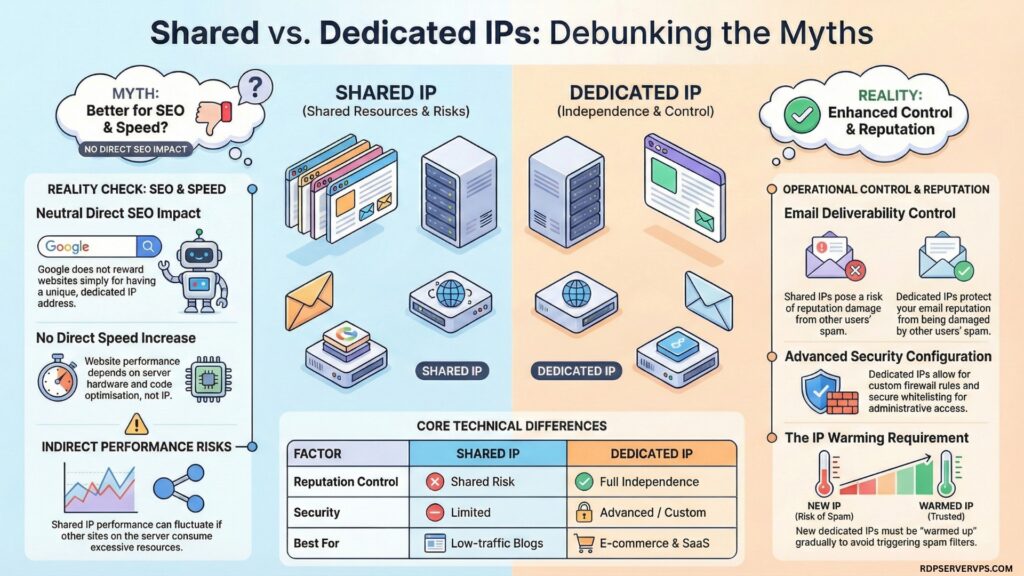
| Factor | Shared IP | Dedicated IP |
| Reputation | Shared with other sites | Yours alone |
| Email reliability | Can be affected by other users | Independent IP standing, but needs warming |
| Speed | Depends on server load | Same: depends on server resources, not the IP |
| Allow-listing | Hard to rely on a shared IP | Fixed IP you can give to partners |
| Cost | Lower | Higher |
SEO Impact: Separating Myth from Reality
There is a common myth that a dedicated IP automatically improves rankings. It does not, and there is no evidence that a unique IP improves rankings. What matters more:
- Page speed
- Content quality
- Backlinks
- Technical optimization
- Uptime stability
Indirect SEO benefits may appear when:
- Your shared IP becomes blacklisted.
- Email campaigns fail due to IP standing issues.
- Server overload affects uptime.
So a dedicated IP does not directly improve SEO, but it can reduce risks that indirectly affect performance.
Email Infrastructure and IP standing
This is where a dedicated IP matters most.
Email servers rely on IP standing databases such as Spamhaus and other blacklist systems. On a shared IP, another user’s spam can hurt your deliverability. With a dedicated IP, your email reputation depends only on your own sending.
A new dedicated IP needs IP warming: start with low volumes and raise them gradually, because sending large volumes at once can trigger spam filters. Ask your hosting provider’s support to set reverse DNS (PTR) for your IP so it matches your sending domain.
Performance: Does a Dedicated IP Improve Speed?
Not directly. Website speed depends on:
- Server hardware (CPU, RAM, NVMe vs SSD)
- Hosting architecture (shared vs VPS vs dedicated server)
- CDN usage
- Caching systems
- Code optimization
In shared hosting, resource spikes from neighboring websites can slow performance. VPS or dedicated server setups are more stable because of resource allocation, not because of IP uniqueness.
Security and Access Control
A dedicated IP gives you more flexibility for:
- IP-based firewall rules
- Allow-listing secure admin logins
- Restricting database access
- Corporate remote access
Security itself depends on server access and firewall configuration, not on the IP type.
IPv4 Exhaustion and Modern Hosting
IPv4 addresses are limited globally, so hosting providers conserve them and usually assign shared IPs by default. Our dedicated server plans include 1 dedicated IP, for example the USA Dedicated Server from $118.99/mo and the 10 Gbps Dedicated Server from $35.93/mo.
Many sites also use a CDN such as Cloudflare. In that case the public IP visitors see belongs to the CDN, not your origin server, so the IP type of your origin matters even less for SEO.
When a Shared IP Is Fine
A shared IP is enough when:
- You run a low-traffic blog.
- You do not send bulk emails.
- You use a reliable hosting provider.
- You use a CDN.
- Budget efficiency matters.
When a Dedicated IP Makes Sense
A dedicated IP becomes valuable when:
- You send transactional or marketing emails.
- You need strict firewall configurations.
- You manage SaaS or client dashboards.
- You need a fixed IP for allow-listing (for example payment or API partners).
- You want full IP history independence.
In these cases the benefits are operational rather than SEO-based. For faster port speeds, compare servers with higher port capacity.
How to Get a Dedicated IP
A dedicated IP comes with our dedicated server plans, so you get one when you order. To set reverse DNS (PTR) for your IP, open a support ticket.
Conclusion
The choice is about control versus cost, not rankings. Choose a shared IP for simple sites and blogs. Choose a dedicated IP for email sending, strict firewall rules or SaaS . Its value is control and IP history.
Frequently Asked Questions About Dedicated IP vs Shared IP
1. Does a dedicated IP improve SEO rankings?
A dedicated IP does not directly improve SEO rankings. It can reduce risks such as spam association, email blacklisting and server instability, which may indirectly support technical SEO health.
2. What is the main difference between shared IP and dedicated IP?
A shared IP is used by many websites on one server, while a dedicated IP is assigned to one website. A dedicated IP gives more control over reputation, email deliverability and security rules.
3. When should you choose a dedicated IP address?
Choose a dedicated IP if you send transactional or marketing emails, need firewall rules or IP allow-listing, or run SaaS or client dashboards.
4. Is shared IP hosting safe for small websites?
Yes. For small websites and informational blogs that do not send bulk email, a shared IP is safe and cost-effective.