

The IP Debate Most Websites Don’t Fully Understand
In hosting discussions, one question appears repeatedly: should you use a shared IP or a dedicated ip? Many blog posts oversimplify this topic, claiming that a dedicated setup automatically improves SEO and speed. That is not entirely true.
An IP address choice does matter — but not always in the way people assume. Its real impact lies in reputation control, email infrastructure, server isolation, and technical trust signals. If you want clarity without myths or marketing bias, this article explains the difference with technical accuracy while staying easy to understand.
Understanding IP Address in Hosting Infrastructure
An IP address (Internet Protocol address) is the numeric identifier assigned to a server connected to the Internet. When someone visits your website, DNS translates your domain into an IP so browsers can locate your server.
In hosting environments, there are two common configurations:
- Shared IP – Multiple websites use the same IP address.
- Dedicated IP address – Only one website is assigned to that IP.
This difference does not change how HTML loads. But it can influence reputation, email systems, security control, and infrastructure management.
Shared IP: How It Actually Works
In shared hosting environments (such as cPanel-based hosting), hundreds of websites can reside on the same server and share a single IP. The server uses Host Headers and SNI (Server Name Indication) to differentiate domains.
This setup is cost-efficient and works perfectly fine for many small websites.
Important Reality Check
Google has publicly stated that shared IP hosting does not directly harm SEO rankings. Millions of websites rank successfully on shared IPs.
However, shared IP environments come with indirect risks:
- If one website sends spam, the IP may appear in blacklist databases.
- Email deliverability can be affected.
- Server performance may fluctuate if another site consumes excessive resources.
- You have limited control over IP reputation.
For low-traffic informational blogs, shared IP is technically sufficient.
Dedicated IP: What It Actually Means
A dedicated ip means your server or hosting account is assigned a unique IP address that no other website uses.
It does not automatically increase speed. It does not magically boost rankings. But it gives you control.
Control over:
- IP reputation
- Email sending history
- Reverse DNS configuration
- Access whitelisting
- Infrastructure stability
This is why businesses, SaaS platforms, and eCommerce stores often use a dedicated ip address.
Core Comparison Table
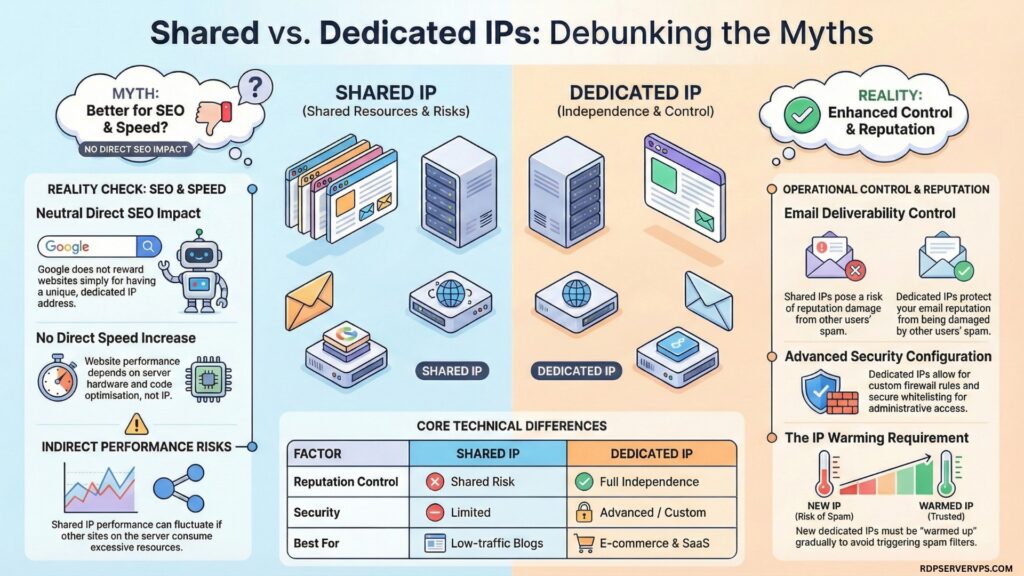
| Factor | Shared IP | Dedicated IP |
| SEO Direct Impact | Neutral | Neutral |
| Reputation Control | Shared | Full Control |
| Email Reliability | Risk of impact | Independent |
| Performance Stability | Depends on server load | More predictable |
| Security Configuration | Limited | Advanced control |
| Cost | Lower | Higher |
This table clarifies an important point: the SEO impact is indirect, not magical.
SEO Impact: Separating Myth from Reality
There is a common myth that using a dedicated ip automatically improves rankings. That is inaccurate.
Google does not reward you for having a unique IP. What matters more:
- Page speed
- Content quality
- Backlinks
- Technical optimization
- Uptime stability
However, indirect SEO benefits may appear when:
- Your shared IP becomes blacklisted.
- Email campaigns fail due to reputation issues.
- Server overload affects uptime.
So while a dedicated ip address does not directly improve SEO, it reduces risk factors that could indirectly affect performance.
Email Infrastructure & IP Reputation
This is where a dedicated approach becomes technically meaningful.
Email servers rely heavily on IP reputation databases such as Spamhaus and other blacklist systems. If you send marketing or transactional emails from a shared IP, another user’s spam behavior can impact your deliverability.
With a dedicated team, your email reputation depends only on your behavior.
However, there is another technical reality:
A new dedicated IP must go through IP warming. Sending high volumes immediately can trigger spam filters. So control brings responsibility.
Businesses using a vpn with static ip or vpn static ip address often combine that with dedicated hosting IPs to maintain consistent authentication and secure outbound connections.
Performance: Does a Dedicated IP Improve Speed?
Short answer: Not directly.
Website speed depends on:
- Server hardware (CPU, RAM, NVMe vs SSD)
- Hosting architecture (Shared vs VPS vs Dedicated Server)
- CDN usage
- Caching systems
- Code optimization
A dedicated ip address alone does not make your site faster.
However, in shared hosting environments, resource spikes from neighboring websites can slow performance. In more isolated setups (VPS or dedicated server), performance is more stable — but that is due to server resource allocation, not just IP uniqueness.
This distinction is important for authenticity.
Security & Access Control Advantages
A dedicated provider provides additional flexibility for:
- IP-based firewall rules
- Whitelisting secure admin logins
- Restricting database access
- Corporate remote access
Organizations often use a vpn unique ip address to ensure secure backend connectivity. When combined with dedicated hosting IPs, infrastructure becomes more predictable and manageable.
For developers and IT teams, this predictability simplifies monitoring and compliance.
IPv4 Exhaustion & Modern Hosting Reality
Another important context: IPv4 addresses are limited globally. Hosting providers conserve IP usage by assigning shared IPs wherever possible.
That is why most websites — including large, legitimate businesses — still operate on shared IPs behind CDNs like Cloudflare.
In CDN environments, the public IP seen by users often belongs to the CDN network, not your origin server. In such cases, whether your origin uses shared or dedicated becomes less visible externally.
This reduces the real-world SEO importance of IP type even further.
When Shared IP is Completely Fine
Shared IP is perfectly suitable when:
- You run a low-traffic blog
- You do not send bulk emails
- You use a reliable hosting provider
- You use a CDN
- Budget efficiency matters
For many informational websites, shared hosting is technically sufficient.
When Dedicated IP Makes Practical Sense
A dedicated ip becomes valuable when:
- You send transactional or marketing emails
- You need strict firewall configurations
- You manage SaaS or client dashboards
- You require consistent authentication via vpn static ip address
- You want full reputation independence
In these cases, the benefits of a dedicated ip address are operational rather than SEO-based.
Final Perspective: Trust, Control & Long-Term Stability
The debate between shared IP and dedicated ip is not about rankings alone. It is about control versus cost efficiency.
Shared IP works for many websites and does not automatically harm SEO.
A dedicated ip address offers greater independence, stronger email management, and more predictable infrastructure control.
If your goal is purely informational blogging with minimal email infrastructure, shared hosting is acceptable. If you manage business-critical systems, reputation-sensitive email campaigns, or restricted access environments, a dedicated IP setup provides meaningful operational advantages.
The correct choice depends on your use case — not marketing claims.
Conclusion
Choosing between shared IP and a dedicated ip should be based on technical needs, not myths. Dedicated IP does not guarantee higher rankings or instant speed improvements. Its value lies in control, reputation isolation, and infrastructure flexibility.
For bloggers and small websites, shared IP is often sufficient. For businesses managing email systems, authentication security, and strict server rules, a dedicated ip address can provide operational stability.
Understanding the difference clearly allows you to make a decision based on facts, not assumptions.
Frequently Asked Questions About Dedicated IP vs Shared IP
1. Does a dedicated IP improve SEO rankings?
A dedicated IP does not directly improve SEO rankings because Google has confirmed shared IP hosting does not harm search visibility. However, a dedicated can reduce risks related to spam association, email blacklisting, and server instability, which may indirectly support overall technical SEO health.
2. What is the main difference between shared IP and dedicated IP?
The main difference is ownership and control. A shared IP is used by multiple websites on the same server, while a dedicated is assigned to only one website. Dedicated IP offers greater control over reputation, email deliverability, and server-level security configurations.
3. When should you choose a dedicated IP address?
You should choose a dedicated IP address when you send transactional or marketing emails, require advanced firewall rules, manage SaaS applications, or need strict authentication control. It is ideal for businesses that need independent reputation management and infrastructure stability.
4. Is shared IP hosting safe for small websites?
Yes, shared IP hosting is generally safe for small websites and informational blogs. If you are not sending bulk emails and your hosting provider maintains clean server practices, a shared IP is cost-effective and technically sufficient for most beginner-level websites.